SERVICES-LED FDI INSIGHTS
Many Roles. One Journey. Lasting Impact.
Foreign direct investment is more than attracting capital. It is the coordinated effort of governments, investment promotion agencies, chambers of commerce, financial institutions, free zones, and private-sector partners working together to create lasting economic value. Through SERVICES-LED FDI INSIGHTS, we explore how every role contributes to a stronger investment ecosystem.
FDI Is Not a Single Event. It Is an Ecosystem.
Every year, governments, investment promotion agencies, chambers of commerce, free zones, financial institutions, and private organizations around the world invest significant time and resources into attracting foreign direct investment (FDI). Trade missions are organized, investment forums are hosted, bilateral agreements are signed, and international delegations travel thousands of miles in search of new opportunities.
Each of these efforts plays an important role.
Yet attracting investment is only one part of a much larger journey.
Too often, FDI is viewed as a single milestone—the announcement of an investment, the signing of a memorandum of understanding, or the registration of a new company. While these are important achievements, they represent the beginning of the investment journey rather than its conclusion.
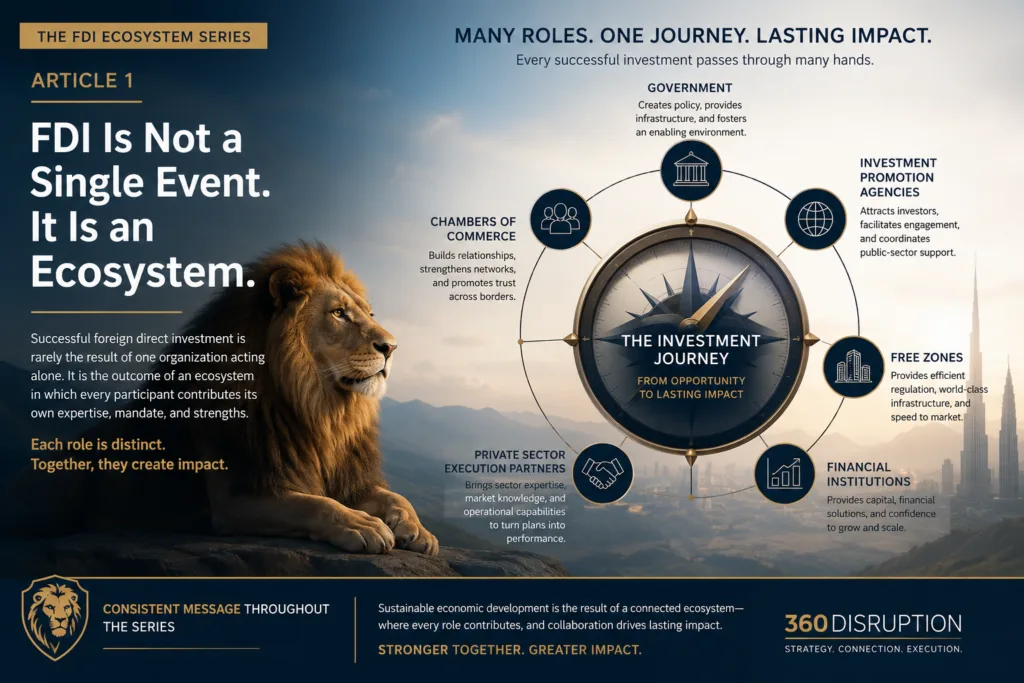
Successful foreign direct investment is rarely the result of one organization acting alone. It is the outcome of an ecosystem in which every participant contributes its own expertise, mandate, and strengths.
Governments establish policies that encourage investment, create regulatory certainty, and invest in the infrastructure that enables economic growth.
Investment Promotion Agencies position their countries or regions as attractive destinations, facilitate investor engagement, and coordinate public-sector support.
Chambers of commerce build relationships, strengthen international business networks, facilitate trade delegations, and create the trust upon which cross-border business is built.
Free zones provide efficient regulatory frameworks, infrastructure, and specialized environments that allow international companies to establish operations quickly and confidently.
Financial institutions provide the capital and financial instruments that enable businesses to expand, localize, and scale.
Private-sector organizations contribute sector expertise, commercial partnerships, operational capabilities, and market knowledge that help companies navigate unfamiliar markets.
None of these roles is more important than another.
They are complementary.
Like the components of an engine, each performs a distinct function. When every component operates effectively and in coordination with the others, investment moves from opportunity to implementation, from implementation to growth, and from growth to lasting economic impact.
This perspective becomes increasingly important as countries compete not only to attract investment, but also to retain it, expand it, and maximize its long-term contribution to economic diversification, innovation, employment, and industrial development.
The conversation is therefore evolving.
Success can no longer be measured solely by the number of delegations received, investment announcements made, or companies registered. Those remain valuable indicators, but they tell only part of the story.
The more meaningful question is:
How many of those opportunities became successful, growing businesses that created jobs, transferred knowledge, generated exports, and contributed to the local economy?
Answering that question requires looking beyond attraction alone and recognizing that FDI is a continuous journey requiring collaboration across multiple institutions and disciplines.
Each participant has a role.
Each role matters.
When those roles work together, foreign direct investment becomes more than capital flowing across borders. It becomes a catalyst for sustainable economic development.
This article is the first in a series exploring the organizations that collectively shape the investment journey. Rather than comparing institutions or questioning their mandates, the objective is to recognize the unique strengths each brings to the FDI ecosystem and to explore how greater alignment between them can help transform opportunity into lasting economic impact.