Most people hear the term “Services-Led FDI” and assume it simply means foreign investment flowing into the services sector — professional services, consulting, logistics, digital platforms, or healthcare delivery. That is the traditional interpretation. It is also incomplete.
Services-Led FDI, as we define and practise it, is not a sector category. It is a pathway.
It is a structured approach to foreign direct investment that deliberately places commercial validation, regulatory navigation, market activation and operational learning before large capital commitments. The sequence is inverted from the conventional model. Instead of attracting capital and hoping operational success follows, the model prioritises evidence of demand and readiness first. Capital follows the evidence.
This distinction matters more than it first appears.
What Services-Led FDI Actually Is
At its core, Services-Led FDI is an execution-first model of market entry and industrial development. It is built on a simple but disciplined principle:
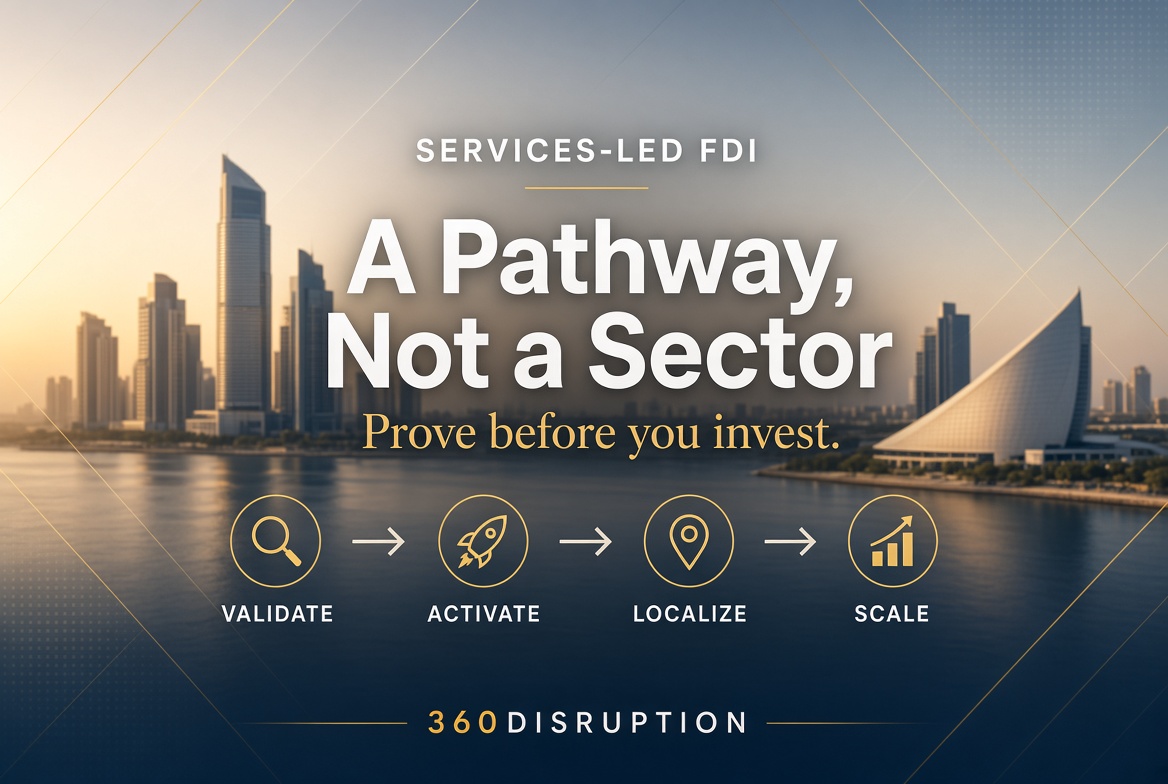
Prove before you invest.
A company does not begin by establishing a large legal entity, leasing significant facilities, or committing substantial capital. It begins by testing real commercial demand, clarifying the regulatory pathway, establishing distribution or partnership channels, and building operational understanding of the market. Only when the evidence supports deeper commitment does the process move toward localisation, facility establishment, and manufacturing.
In practice this creates a progressive pathway:
- Market access and commercial validation
- Operational presence and partnership building
- Evidence-based localisation decisions
- Capital commitment and industrial scale only when justified
The model is particularly relevant for advanced technology, healthtech, diagnostics, specialised manufacturing and other innovation-led companies that face both regulatory complexity and commercial uncertainty in new markets. It reduces the risk of premature capital deployment while still moving companies toward genuine economic participation.
Importantly, Services-Led FDI does not reject manufacturing or industrial investment. It simply refuses to begin there when the commercial foundation has not yet been proven. Manufacturing becomes the logical outcome of demonstrated demand rather than a speculative starting point.
What Services-Led FDI Is Not
It is not FDI into the services sector.
It is not a softer or lighter form of traditional investment attraction.
It is not advisory consulting dressed up as investment support.
It is not a model that stops at market entry or licensing.
And it is not a substitute for industrial strategy. On the contrary, when executed properly it becomes one of the most effective feeders into industrial strategy — because the companies that eventually localise and manufacture have already validated customers, channels and regulatory reality.
Traditional FDI metrics still focus heavily on capital committed, licences issued and projects announced. Services-Led FDI measures something more demanding and more useful: actual commercial traction, operational readiness, and the conversion of interest into sustained economic activity.
Why the Distinction Matters
For international companies, the difference is risk. Many firms have established a legal presence in a new market only to discover that customer acquisition is slower, regulatory pathways are more complex, or distribution is harder than expected. Capital is already committed. The cost of exit or underperformance is high. Services-Led FDI is designed to surface those realities earlier, while the financial and operational exposure remains limited.
For destinations, the difference is conversion quality. Attracting investment interest is relatively easy. Converting that interest into genuine economic participation — revenue generation, local employment, technology transfer, and eventual manufacturing — is far harder. Destinations that optimise only for attraction metrics often accumulate pipelines of underperforming or idle projects. Destinations that build strong activation and progressive enablement capacity convert more of that pipeline into real economic activity.
This is particularly relevant for mid-sized and specialised companies. A €50 million advanced manufacturing or healthtech firm can be relatively insignificant in a vast investment ecosystem. In a more accessible environment that prioritises progressive enablement, the same company can receive direct institutional attention and practical support. Size, in this context, becomes an advantage rather than a limitation.
A Different Product
The practical implication is straightforward. Services-Led FDI offers companies a different product from traditional investment promotion.
Traditional messaging often emphasises location advantages, incentives, infrastructure and ease of setup. These remain relevant. But they do not address the central risk most companies actually face: whether the market will respond commercially once the capital is deployed.
Services-Led FDI addresses that risk directly by making commercial activation the first priority. It allows a company to test demand, navigate regulation, establish partnerships and build operational experience before deciding on the scale and form of its long-term commitment.
In the UAE context, this creates space for a differentiated proposition. The question is no longer only which emirate offers the strongest brand, the deepest capital pools, or the lowest setup costs. A more precise question becomes available: which environment best allows a company to prove the opportunity progressively before carrying the full economic weight of a major market presence.
That is the strategic opening Services-Led FDI creates.
It is not a softer form of FDI. It is a more rigorous one.
Grounded in the 360Disruption Method—Observe. Discover. Strategize. Execute. Make Impact.—the series seeks to contribute to the global conversation on how investment ecosystems can evolve to create stronger businesses, more resilient industries, and greater economic value.