How different industries progress from validation to localization
Services-Led FDI is not a single rigid process. While the core principle remains constant — prove before you invest — the practical pathway changes according to the nature of the sector, its regulatory burden, and the type of commercial evidence required.
Different industries face different forms of uncertainty. A diagnostics company must clear regulatory and clinical hurdles. An AI platform must prove enterprise or government adoption. A logistics operator must demonstrate real demand and operational reliability. An infrastructure solution often depends on municipal or PPP pilot access.
The sequence stays the same. The content of each gate changes.
The Common Architecture
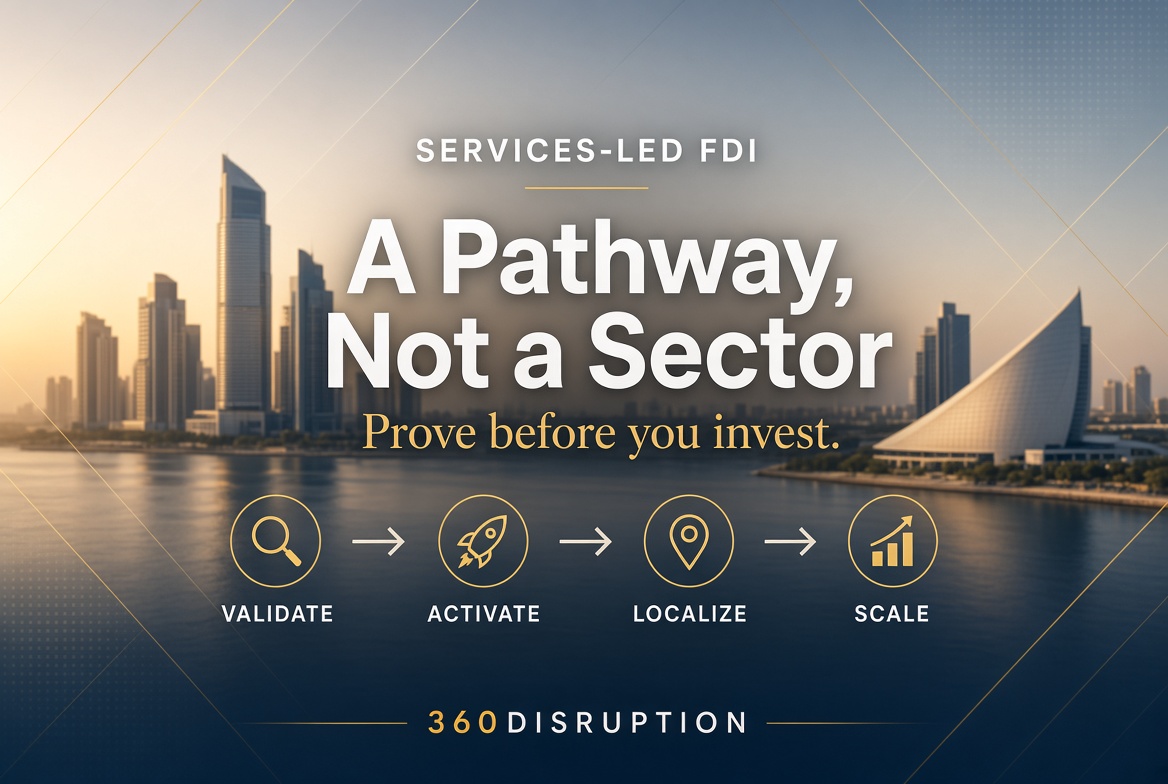
Across all sectors, the progression follows the same logic:
- Qualify & Define — Is the company and opportunity strategically relevant?
- Validate — Does real commercial and regulatory evidence support further commitment?
- Activate — Can the company generate early traction and operating presence?
- Localize — Does the evidence justify deeper economic participation (people, supply chain, facilities)?
- Industrialize / Scale — Is larger capital investment now justified by proven demand?
What differs is the nature of the critical validation gate and the form that localization eventually takes.
Sector Pathways
Healthcare & Life Sciences
Primary early uncertainty: regulatory approval (MOHAP / EDE), clinical acceptance, and distribution access.
Critical validation gate: controlled commercial or clinical pilot, often through pharmacy, retail, or healthcare partners.
Typical progression: regulatory pathway clarity → pilot → first commercial revenue → local operating presence → assembly or light manufacturing.
Natural outcome: regional diagnostics, medical devices, or specialty healthcare footprint.
Digital Transformation & AI
Primary early uncertainty: data residency, procurement cycles, and real enterprise or government buying behaviour.
Critical validation gate: paid Proof-of-Concept with a genuine local buyer.
Typical progression: PoC → first contracts → local delivery team → possible regional operations or data node.
Natural outcome: specialized technology delivery centre or AI services hub.
Logistics & Manufacturing
Primary early uncertainty: actual demand volume, customs performance, cold-chain reliability, and offtake security.
Critical validation gate: asset-light warehouse, distribution, or contract manufacturing trial.
Typical progression: demand validation → logistics activation → local warehousing → industrial investment.
Natural outcome: high-value manufacturing, temperature-controlled logistics, or e-commerce fulfilment base.
Infrastructure (Circular Economy & Smart Mobility)
Primary early uncertainty: municipal willingness, access to real operational data or waste streams, and PPP readiness.
Critical validation gate: municipal or PPP pilot agreement.
Typical progression: pilot → limited operational contract → formal PPP structure → full infrastructure asset.
Natural outcome: recycling facilities, sorting centres, or smart mobility systems under long-term partnership models.
Tourism & MICE
Primary early uncertainty: real seasonal and corporate demand, and integration with local hospitality ecosystems.
Critical validation gate: soft-run events or micro-conferences that test actual spend and operational fit.
Typical progression: demand testing → service activation → local operational presence → physical facilities.
Natural outcome: permanent event capacity or regional MICE operations centre.
Why This Differentiation Matters
A one-size-fits-all investment process forces every company through the same early capital and licensing requirements, regardless of where the real uncertainty lies. This creates unnecessary risk and frequently leads to premature commitments.
A sector-aware Services-Led approach matches the validation method to the actual risk. Regulatory-heavy sectors are de-risked through pilots and pathway clarity. Demand-uncertain sectors are de-risked through commercial trials. Infrastructure projects are de-risked through controlled pilot access.
The result is higher quality progression. Companies that advance do so with evidence. Companies that should not advance are identified earlier, protecting both the investor and the destination.
Strategic Implication for Ajman
Ajman’s compact institutional environment is particularly well suited to this differentiated approach. Faster access to decision-makers, shorter coordination cycles, and the ability to structure practical pilots give the Emirate a structural advantage in moving companies through early validation phases more efficiently than larger, more complex ecosystems.
The opportunity is not to treat every sector the same.
It is to apply the same disciplined principle — evidence before irreversible commitment — while adapting the pathway to the realities of each industry.
That is how Services-Led FDI converts international interest into durable economic participation, sector by sector.
Grounded in the 360Disruption Method—Observe. Discover. Strategize. Execute. Make Impact.—the series seeks to contribute to the global conversation on how investment ecosystems can evolve to create stronger businesses, more resilient industries, and greater economic value.