
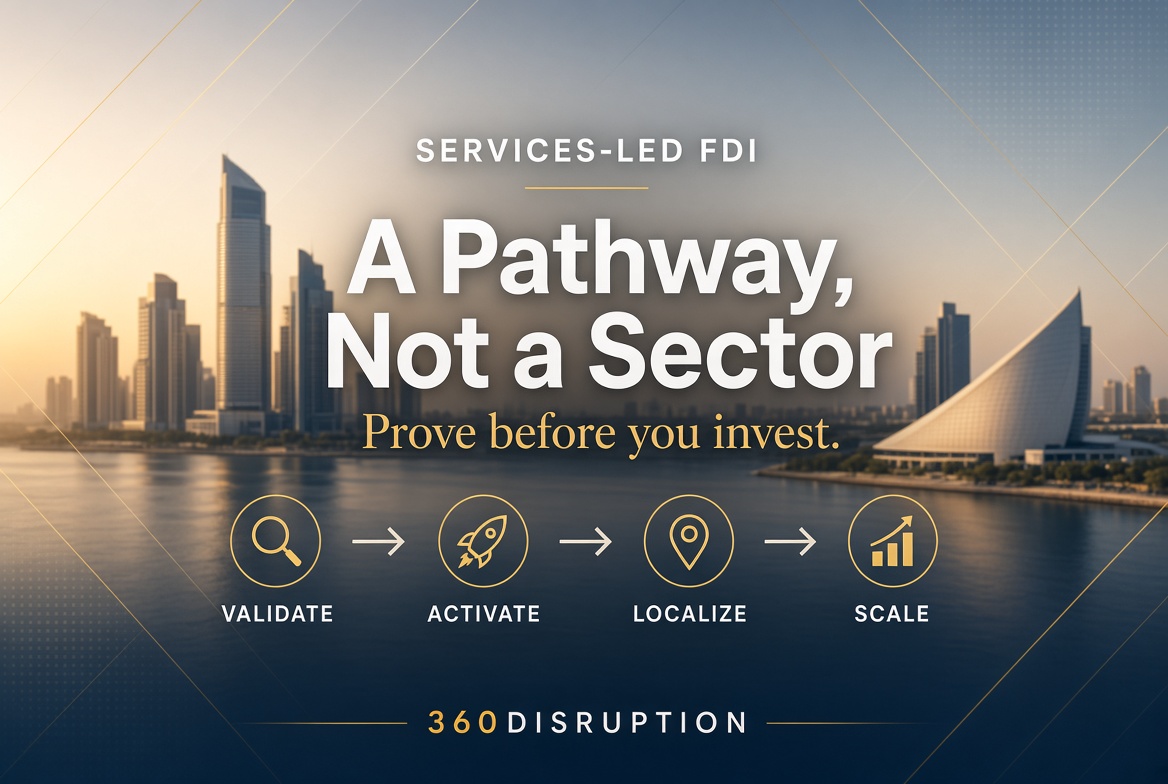
Most discussions of foreign direct investment still treat FDI as a single concept. In reality, there are two fundamentally different approaches — and the difference determines whether investment creates lasting economic value or simply transfers risk from the company to the destination.
Traditional FDI: Capital First
Traditional FDI begins with capital commitment. A company decides to enter a market, establishes a legal entity, secures licences, leases or builds facilities, hires staff, and only then begins the hard work of finding customers, navigating regulation, and proving commercial viability.
This model works when the market is already well understood, the regulatory pathway is clear, and the company has both the capital and the appetite for significant early-stage risk. It is the dominant model for large multinational corporations and for destinations that compete primarily on scale, incentives, or brand recognition.
The weakness of traditional FDI is structural: the largest financial and operational commitments are made before the most important questions have been answered. Does a real market exist at the price and volume required? Can the product clear regulatory barriers efficiently? Will local partners and distribution channels perform? Will the business model survive local operating conditions?
When the answers to these questions turn out to be negative, the result is stranded capital, abandoned licences, and failed projects. Destinations inherit the consequences: underutilised facilities, unfulfilled job commitments, and a quieter form of investment failure that rarely appears in official statistics.
Services-Led FDI: Evidence First
Services-Led FDI reverses the sequence.
It begins with commercial and regulatory validation. The company enters the market through structured services — market testing, regulatory pathway assessment, customer and partner development, distribution trials, and progressive operational presence. Only when the evidence supports further commitment does the company move toward formal establishment, localisation, and eventually manufacturing or larger capital investment.
The core principle is simple: prove before you invest.
This is not a softer or less ambitious form of FDI. It is a more disciplined one. Capital is still deployed — often at significant scale — but it is deployed after the critical uncertainties have been reduced. The result is higher survival rates, faster time-to-revenue, and investment decisions grounded in demonstrated opportunity rather than projected hope.
The Critical Differences
| Dimension | Traditional FDI | Services-Led FDI |
|---|---|---|
| Starting point | Capital commitment | Commercial & regulatory validation |
| Risk sequence | High risk first | Progressive risk reduction |
| Licence timing | Early | When justified by evidence |
| Facility investment | Often premature | Demand-led and phased |
| Failure mode | Stranded capital | Controlled exit or adjustment |
| Destination value | Announced investment | Sustained economic activity |
| Company experience | High early cost of learning | Learning before irreversible commitment |
Why the Distinction Matters for Destinations
Destinations that compete primarily on traditional FDI metrics — number of licences issued, announced capital, square metres of facilities — optimise for volume of entry rather than quality of outcome. This creates an incentive structure that can favour rapid but fragile investment.
A Services-Led approach optimises for a different outcome: the conversion of international interest into durable economic participation. It measures success not only by how many companies arrive, but by how many progress successfully through commercial activation, establishment, localisation, and contribution to the local economy.
This distinction is particularly relevant for destinations that cannot, and should not, compete solely on the scale or brand power of larger hubs. The competitive advantage lies in offering a lower-risk pathway for companies that need to prove the market before they can justify larger capital commitments.
Why Services-Led FDI Often Leads to Manufacturing
A common misconception is that a services-led approach somehow delays or dilutes industrial outcomes. The opposite is true.
Companies that begin with validation tend to make more informed and durable localisation decisions. By the time they commit to manufacturing or advanced facilities, they already understand demand, regulatory requirements, partner ecosystems, and operating realities. The manufacturing investment is therefore more likely to succeed and to expand.
Traditional FDI can produce manufacturing announcements. Services-Led FDI is more likely to produce manufacturing that lasts.
The Strategic Implication
The choice is not between “attracting investment” and “not attracting investment.” It is between two different philosophies of how investment should be sequenced and de-risked.
Traditional FDI asks companies to commit first and learn later.
Services-Led FDI asks companies to learn first and commit when the evidence supports it.
For destinations serious about converting investor interest into sustained economic participation, the second approach is not merely an alternative. It is a more reliable engine.
Grounded in the 360Disruption Method—Observe. Discover. Strategize. Execute. Make Impact.—the series seeks to contribute to the global conversation on how investment ecosystems can evolve to create stronger businesses, more resilient industries, and greater economic value.